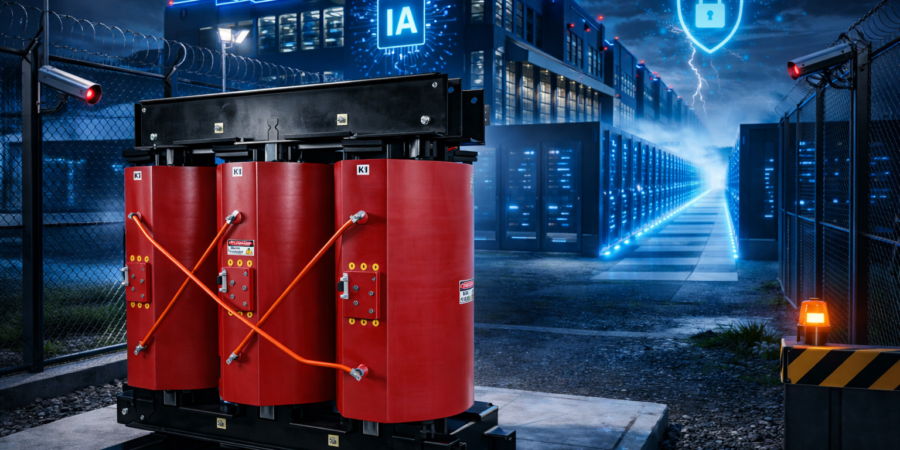
Data Center Transformers: Why Dry-Type Transformers Are the Safest Choice for Critical Infrastructure
Discover how to specify transformers for data centers: 480 V, K-factor,
harmonics and why the dry transformer is the best choice for
critical environments.
Introduction: Why the Topic Gained Relevance
The accelerated growth of data centers in Brazil and around the world has transformed
deeply the electrical specification criteria.
Unlike traditional industrial environments, where loads are predominant
linear (motors, resistive heating), data centers concentrate UPS,
Rectifiers, switching power supplies, high-density racks, and electronic systems
sensitive.
This scenario completely changes the behavior of the electric charge.
As a consequence, two requirements have become recurring in projects:
– 480 V output
transformer with high K-factor
This is not a trend, it's a direct technical requirement of the data architecture.
Modern centers.
Why 480 V Is the Standard in Data Centers
The decision to use 480 V for low voltage follows a basic engineering principle
Electrical:
For the same power, higher voltage means lower current.
Direct impacts of this choice:
– reduction of electrical losses (I²R)
– less heat buildup in cables and connections
– optimization of the conductor cross-sectional area
– improved overall system efficiency
In addition, most large UPS systems naturally operate at
480 V, eliminating intermediate transformation steps.
Practical Comparison
Rating: 380/400 V, 480 V
Current for the same power: Higher Lower
Electrical losses Higher Lower
Optimized Larger Cable Gauge
Integration with UPS Limitada Natural
Technical conclusion: 480 V is more efficient, more compatible, and more suitable
for high load density.
The Real Challenge: Harmonics in Data Centers
The most critical point is not the voltage – it's the load profile.
Data centers are dominated by nonlinear loads, such as:
switching power supplies (servers)
UPS (rectifier/inverter)
electronic converters
These loads do not consume sinusoidal current, causing distortions known as
harmonics.
Main harmonics present:
Tuesday
Thursday
7th
9th
11th grade and above
K-factor: the critical indicator for transformers
The K factor measures the thermal impact of harmonics on the transformer.
The higher the K factor, the greater the transformer's ability to withstand
distorted currents without overheating.
Application of the K Factor: Interpretation
Linear load K1: No significant harmonics
Mild TI K4–K9 Moderate distortion
K13 Standard Data Center: High Harmonic Content
High Density / IA K20+ Severe Condition
Key point: A conventional transformer can apparently operate
within the power rating, but fail thermally in an environment with harmonics.
Where harmonics affect the transformer
Harmonics alter the distribution of internal losses:
– increased eddy currents
– skin effect
– proximity effect
– localized heating in windings
Pay special attention to the triple harmonics (3rd, 9th, 15th):
– they do not cancel each other out between phases
– they add up to zero
– can cause significant overcurrent
Result: high risk of overheating and failure.
What Changes in the Design of a Data Center Transformer
A data center transformer is not a standard transformer.
It requires specialized engineering:
– thermal sizing for nonlinear loads
– reduction of further losses
– neutral current control
– durability for continuous operation (24/7)
– compatibility with MT / 480 V architecture
Why is a dry-type transformer the best choice?
For critical applications such as data centers, the dry-type transformer offers
clear advantages:
– greater safety (no flammable oil)
– ideal for indoor installation
– lower environmental risk
– high operational reliability
– better performance in critical applications
União Transformers: A Solution Tailored to the Modern Data Center
When the market requires medium voltage, a 480 V output, a high K-factor, and
For continuous operation, he is requesting engineering equipment
practical and highly reliable.
Transformadores União is built on three pillars:
- Application-Oriented Engineering
Design based on the actual load profile—not just the nameplate. - Focus on dry-type transformers
Secure, robust solutions that are ideal for critical environments. - High level of customization
– K factor (K13, K20, etc.)
– specific voltages
– thermal requirements
– integration with UPS and client architecture
Frequently Asked Questions:
What is the best transformer for a data center?
The most suitable is the medium-voltage dry-type transformer, with a 480V output
And K is high.
Why do data centers use 480 V?
Because it reduces current, electrical losses, and cable sizing, as well as
to be compatible with UPS.
Why is the K-factor important?
Non-linear loads generate harmonics that increase heating
to transformer.
Can a standard transformer be used?
It is not recommended, as overheating and reduced lifespan may occur.
useful.
Are dry-type transformers suitable for data centers?
Yes. It is the safest and most suitable solution for critical and indoor environments.
Conclusion
Properly specifying a data center transformer requires considering the following:
– voltage level (480 V)
– harmonic content (K factor)
– actual operating profile
Ignoring these factors can lead to premature failures, a reduced service life, and
operating losses.
The dry-type medium-voltage transformer, properly designed for
Harmonics is the most suitable solution for modern data centers.
Transformadores União positions itself as a technical partner for applications
critical applications that require safety, reliability, and high-level engineering.
 Português do Brasil
  English
  Español