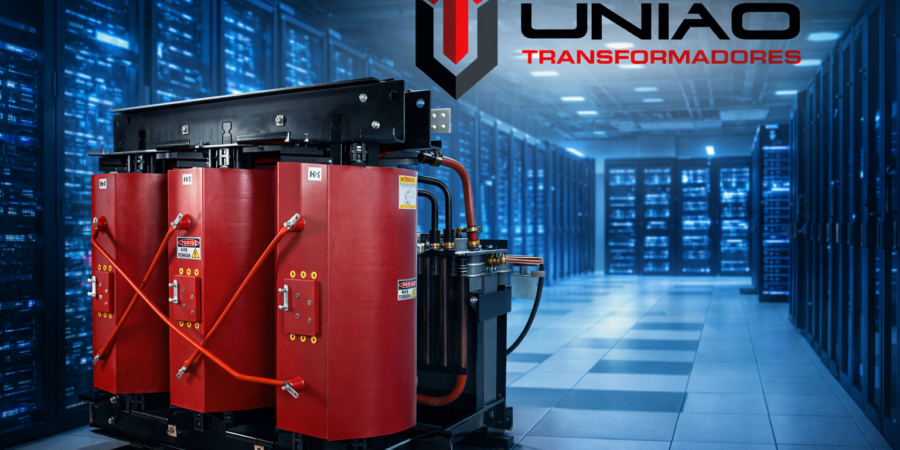
Data Center Transformers: Why Dry-Type Transformers Are the Safest Choice for Critical Infrastructure
Electrical safety, operational reliability, and service continuity in modern data centers
Introduction
Data centers are the backbone of the digital economy. Cloud services, banking systems, telecommunications, streaming platforms, and artificial intelligence applications rely on infrastructure capable of operating continuously and without interruption.
In this context, the electrical infrastructure of a data center is one of the most critical elements for ensuring operational availability. Any failure can result in service interruptions, data loss, and significant financial losses.
Among all the electrical equipment present in a data center, medium-voltage transformers play a central role. They are responsible for adapting the power supplied by the electrical grid to the voltage levels suitable for the internal distribution of the facility.
For this reason, the choice of transformer technology should prioritize three fundamental factors: electrical reliability, operational safety, and service continuity.
The electrical infrastructure of a data center
Data centers are designed to operate at extremely high levels of availability. In many cases, the operational goal is to achieve 99.999% of uptime.
To achieve this level of reliability, the electrical architecture includes several redundant systems, such as medium-voltage substations, power transformers, UPS systems, emergency generators, and redundant electrical distribution systems.
Within this structure, medium-voltage transformers act as the connection point between the external power grid and the internal infrastructure of the data center.
The role of medium-voltage transformers in data centers
Medium-voltage transformers convert the electrical grid's voltage levels to those used for internal data center distribution.
They power critical systems such as UPS, distribution panels, HVAC systems, and the infrastructure that supports the servers.
In addition to voltage transformation, these pieces of equipment must demonstrate high operational reliability, thermal stability, electrical safety, and a low probability of catastrophic failures.
Dry-type transformers vs. oil-filled transformers
There are two predominant technologies for medium-voltage transformers: oil-filled transformers and dry-type transformers.
Oil transformers use insulating oil for cooling and electrical insulation. Dry transformers, on the other hand, use solid insulation based on special resins and do not use insulating liquids.
Although both technologies perform the same electrical function, there are important differences related to operational safety and risk management.
Risks associated with oil transformers
Transformers using insulating oil present specific operational risks due to the presence of flammable fluid.
Internal failures, short circuits, or overheating can ignite insulating oil, resulting in fires. In more severe situations, gas accumulation and increased pressure inside the transformer tank can occur, potentially leading to explosions.
In critical environments like data centers, events like this can cause significant operational disruptions and damage to electrical infrastructure.
Dry transformers are safer because they do not use flammable liquids like oil. This eliminates the risk of fire and explosion. They also produce fewer emissions, making them more environmentally friendly.
Dry transformers eliminate one of the main risk factors associated with conventional transformers: the presence of flammable liquids.
Since they do not use insulating oil, the risks associated with fires are significantly reduced. Furthermore, the risk of oil-related explosions is also eliminated.
These characteristics make dry-type transformers particularly well-suited for critical environments such as data centers.
Additional advantages of dry transformers in data centers
Besides safety, dry transformers offer other important advantages, such as a lower environmental impact, no risk of oil leakage, and a reduced need for containment infrastructure.
They also allow for installation closer to critical loads, contributing to the optimization of electrical distribution within facilities.
Applications in modern data centers
The growth of the digital economy has driven the construction of different data center models around the world.
Among them are large-scale processing facilities, regional structures that bring digital services closer to users, and shared environments used by multiple companies.
Regardless of the operating model, all these environments share a common characteristic: the need for extremely high electrical reliability.
Transformadores União: engineering and reliability
Transformadores União acts as a specialized manufacturer of medium and low voltage transformers, providing solutions for industrial applications and critical infrastructure.
The company stands out for its specialized engineering, high industrial quality standards, and focus on operational reliability, developing equipment designed to meet the demands of applications requiring safety and continuity of service.
Conclusion
Data centers are environments where security and electrical reliability are essential requirements.
Medium-voltage transformers play a central role in this infrastructure and need to offer high performance combined with reduced operational risks.
Dry transformers eliminate the risks associated with the presence of flammable fluid, making them a naturally safer solution for critical applications such as data centers.
Comparison: Dry Transformer vs. Oil-Immersed Transformer
| Characteristic | Dry Transformer | Oil transformer |
| Security | Too high | Moderate |
| Fire risk | Very low | Present due to the oil |
| Explosion risk | Deleted | Possible in internal failures |
| Maintenance | Download | Moderate |
| Environmental impact | Reduced | Possible oil contamination |
| Data center suitability | Excellent | Limited |
Frequently Asked Questions
 Português do Brasil
  English
  Español